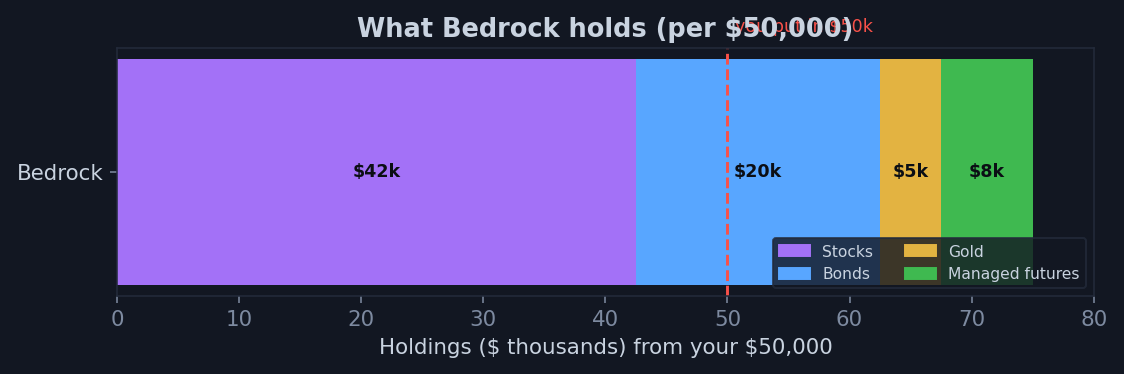
Buy, hold, and stay calm
We buy a diversified basket and hold it through the ups and downs, rebalancing lightly once a month. We don't day-trade, chase headlines, or forecast the market, and ordinary dips and volatility are simply held through. That alone captures long-term market growth without the drama, and it quietly beats the vast majority of active investors, who lose to their own timing and emotions. The one exception is a genuine crisis: instead of riding a true breakdown all the way down, Bedrock has an automatic safeguard that steps the basket to safety, more on that below.
Building block twoReturn-stacking, the part that lifts it above an index fund
This is genuinely institutional-grade, the same capital-efficiency principle used by pensions and argued by AQR's Cliff Asness in "Why Not 100% Equities." Here it is, plainly:
Think of a house down payment
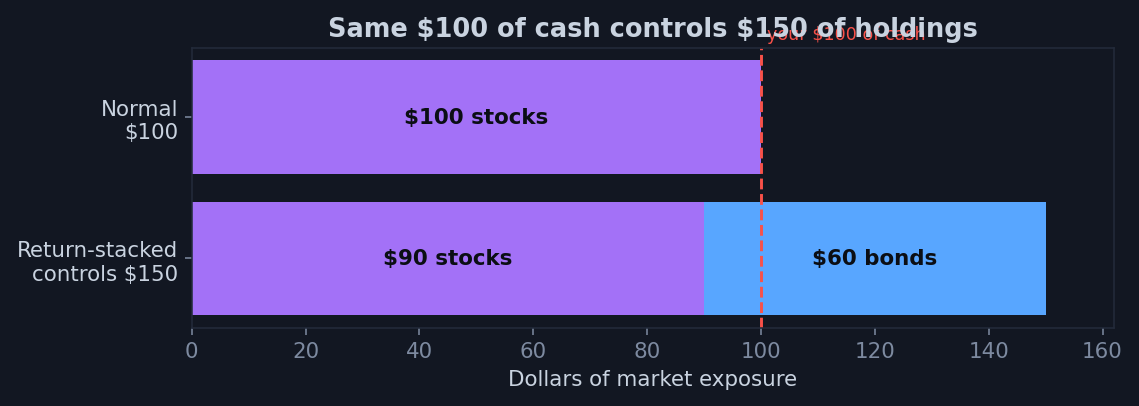
When you buy a $500,000 house you don't pay $500,000. You put ~$100,000 down and control the entire house. If it rises 10%, you made 50% on your cash. Nobody calls a down payment exotic.
Return-stacking applies the same idea to bonds and other diversifiers. To be direct about the mechanics: no options, no futures contracts, no day-trading. Today, that extra exposure is financed through standard margin in your brokerage account. One holding in the basket, a managed-futures fund, carries built-in leverage of its own; the rest of the stack is financed through account margin.
Why it helps
Stocks and bonds usually move opposite each other, so the stacked-on bonds are a shock absorber that also earns its own return, and you never gave up stock exposure to get it. More return most years, a smoother ride.
The honest catch
It cuts both ways, like the house. In a rare year when stocks and bonds fall together, the modest leverage magnifies the loss. That was 2022. The strategy is built to hold through an ordinary bad year, and the crash safeguard below is designed to limit exactly this kind of deep drawdown.
An automatic crash safeguard, a seatbelt, not a market timer
Holding through ordinary volatility is the right call almost always. But a genuine market breakdown is different, and that is where most investors get hurt. So Bedrock watches a single, systematic macro signal, tracking the momentum of inflation and interest rates, and checks it once a day.
How it behaves
The signal blends how conditions have moved over the past 1, 3, 6, and 12 months, weighted toward the most recent months, not a single flat reading. When the signal is healthy, which is most of the time, Bedrock holds the full basket and does nothing. When that inflation and interest-rate momentum turns negative, the whole book rotates into Treasuries for safety, and stays there until conditions recover, then steps back into the basket. It is rules-based and automatic, with no discretion or forecasting. We tested stacking on other signals too, including breadth, volatility term structure, and credit spreads, and none improved the result, so we kept the one that's proven itself, not added complexity for its own sake.
What it is not
This is not forecasting, stock-picking, or reacting to every scary headline, and it is not a guarantee against every kind of drop. It follows one systematic rule, tied to inflation and interest-rate momentum, and it is built to catch the sustained, rate-driven stress behind 2008 and 2022, not a sudden one-day shock unrelated to rates. Think of it as a seatbelt: quiet until the moment it matters, and built for a specific kind of crash.